
Autism Resource Services is a designated multidisciplinary team that is a part of the continuum of existing DDSB supports for students with Autism Spectrum Disorder. The Autism Resource Team (ART) consists of members from Psychological Services (Board Certified Behaviour Analysts), Instructional Facilitators and Speech/Language Pathologists. The ART team provides assessment, consultation and in-school mentoring and modelling of strategies to build skills that promote student success.

Inclusive Student Services
Inclusive Student Services provide a range of services, supports, programs and placements for students with special education needs in the Durham District School Board (DDSB). Students' needs are met through a variety of supports and programs within the DDSB at both the elementary and secondary levels. All programs promote integration and independence that are optimally suited for each individual student.
The DDSB is committed to fostering success and independence for each student by providing a range of pathways, programs, opportunities and services that are responsive to individual identities (including intersecting identities), strengths and needs. Students with special education strengths and needs are supported in inclusive environments that enable them to develop to their potential.
Students are at the centre of all planning. Our ongoing commitment is to provide the structures and supports each student needs to nurture their growth and development in programs which respect dignity, maximize participation, and foster integration and independence as defined for each student based on their individual strengths and needs.
We work with parent(s)/guardian(s) and district staff to determine the placement that best addresses barriers and meets the student’s individual needs (whether that is in a regular classroom, or for some students, in a special education class) and to provide appropriate accommodations, where required. This is in keeping with DDSB’s roles and responsibilities under the Ontario Human Rights Code, the Education Act, and DDSB policies and procedures (including the Human Rights, Anti-Discrimination and Anti-Racism Policy, the Human Rights Inclusive Design and Accommodation Procedure and related procedures). Reference: DDSB Inclusive Student Services Special Education Plan 2026-2027.
For most students with special needs, their families choose programming and supports through regular class placements, with an appropriate level of accommodations and/or modifications to their program. Special education classes are also options and provide a greater intensity of support for students who require this level of programming for their success. Together with classroom teachers, Special Education Resource Teachers (SERTs) and Administrators form the core of a student's school team
2026-2027 Inclusive Student Services Special Education Plan
Impact Updates
2025-2026
- Role of the SERT - Vol. 3, Issue 4
- Supporting Student Mental Health and Well-Being—Community Partnerships - Vol. 3, Issue 3
- Supporting Student Engagement and Attendance - Vol. 3, Issue 2
- Regular Class Placement - Vol. 3, Issue 1
2024-2025
- Professional Learning to Support Shifts Towards Anti-Oppressive Practices - Vol. 9
- Speech and Language Services - Vol. 8
- Deaf and Hard of Hearing Student Supports - Vol. 7
- Blind and Low Vision Student Supports - Vol. 6
- Work Education- Vol. 5
- Service Animals in Schools - Vol. 4
- Practical Learning Program - Vol. 3
2023-2024
- Augmentative and Alternative Communication - Vol. 10
- Developmental Program - Vol. 9
- Social Work - Vol. 8
- Transition to Work Program - Vol. 7
- Education Community Partnership Program Grove School - Vol. 6
- Student Mental Health and Well-Being - Vol. 5
- Special Education Advisory Committee - Vol. 4
- Psychological Services - Vol. 3
- Classroom Support Staff - Vol. 2
- Specialized Equipment - Vol. 1
Services
Child and Youth Support Worker
The Child and Youth Support Worker Team supports building the capacity of educators and support staff to foster mentally healthy classrooms through the implementation of social emotional learning and mental health promotion strategies into the instructional day. Team members provide in-school mentoring and modelling of strategies developed in collaboration with the school team to build skills to promote student success.
The Inclusive Technology team provides support to students who require technology to access curriculum. Inclusive Technology facilitators support classroom teachers in implementation of technology into their daily program, and the Inclusive Technology trainers provide hands-on learning for students and their families to help them become proficient users of a variety of software and hardware. This team is always looking for additional resources to support the diverse needs of our students.
Special Education Facilitators are centrally assigned teachers, guided through the leadership of the System Lead-Special Education and the Superintendent of Inclusive Student Services. Special Education Facilitators may have responsibilities to support a Family of Schools, Innovative (Assistive) Technology or Gifted Programming. Facilitators support school staff in meeting the needs of students with special education strengths and needs, provide guidance and professional collaboration. Facilitators also liaise with schools and parents/guardians, assisting all stakeholders in determining the most appropriate program and placement for students.
Psychological Services staff provide five service functions for the DDSB: consultation, assessment, direct service, crisis response and capacity building. Each service function serves to assist staff, students and families access school programming in a way that seeks to ensure that student needs related to learning, development, social and behavioural functioning, and mental health are met in an inclusive manner.
Short-Term Assistance Response team (START)
The Short-Term Assistance Response Team (START) provides support to classroom teachers and school teams in programming for students with specialized needs which include challenging behaviours that may interfere with adequate school functioning. The team includes members of Psychological Services, Instructional Facilitators and specially trained Educational Assistants who provide in-school mentoring and modelling of strategies developed in collaboration with the school team to build skills to promote student success.
Speech, Language and Hearing Services
Speech, Language and Hearing Services provides students with educational support to help them develop effective communication skills. We also offer a number of resources to parents to support their child's development.
Social Work and Attendance Services
Social Work and Attendance Services support students who have personal or family issues that are influencing their ability to access learning effectively. Social Work staff identify the issues affecting student attendance and school functioning. The team works with students, parent(s)/guardians and school staff to find conducive solutions
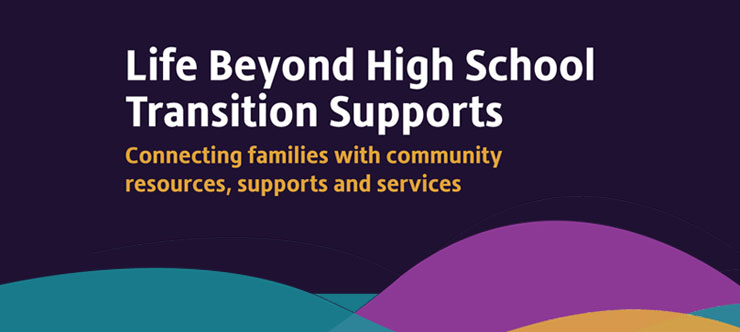
Transition Coordinator Team supports school teams in developing Individual Education Transition Plans for Special Education students, by implementing a student-focused approach that identifies the student’s goals for work, further education and life in the community.
The team collaborates with community partners to create opportunities for students with special education needs to practice and refine classroom-based practical learning skills in real-world workplace settings. Transition Coordinators work with teachers and school staff so that students can access work placements safely and develop employability and life skills on work sites through supervised, structured, and guided practice.
This coordinated planning allows our students and their families to plan, connect to services and programs, set goals with their school teams, and access appropriate community agencies to reach their full potential.
Click on the image below to view available Transition supports.
Vision Resource teachers have an integral role to support the learning needs of students with vision impairments or related learning exceptionalities who require support to access the curriculum. Services may include direct service to students and/or consultation services to support visual accommodations.
Programs for students with Special Education strengths and needs
Students’ needs are met through a variety of programs and placements within the DDSB. We strive to help every student meet their full potential, while fostering the highest level of independence possible for each student. We place a strong emphasis on the inclusion of our students with special needs, providing meaningful, individualized integration opportunities for students accessing special education programs.
The Provincial framework outlines five potential placement options for students formally identified through IPRC process. However, school boards are not required to offer all five of these placement options. At the DDSB, we primarily use three placements: (i) Regular Class with Indirect Support; (ii) Regular Class with Withdrawal Assistance; and (iii) Regular Class with Resource Assistance. Information is shared publicly on our website for the supports and use of Regular Class with Indirect Support. We use Regular Class with Withdrawal Assistance and Regular Class with Resource Assistance for the relatively small number of students accessing direct teaching by Itinerant (teachers with specialized certifications working in multiple schools) for students who are Blind/Low Vision or Deaf/Hard of Hearing.
The majority of students with special education needs access programming in a regular classroom. For most students a classroom teacher, with support of the school’s Special Education Resource Teacher and board staff, is able to provide individualized programming that allows the student to meet with success in a classroom environment with their peers. The Board’s practice is that, whenever possible, special learning needs are supported within the home school and within a regular class placement. The regular class placement is considered the most inclusive of placements.
Placements for a student identified through the IPRC process address where the student is accessing their learning (regular class or special education class) and access to special education qualified teachers. It is important to note that placement does not indicate any specific educational assistant support.
Special Education Class Placements
Some students require a higher level of support, more intensive intervention and specialized services to meet with success. For those students, parent/guardian(s) may be offered an opportunity to explore the option of a Special Education Class placement for their child. In the DDSB, we provide eight special education class types that have clearly defined outcomes for student success and are designed to meet the needs of students with specific learning profiles.
Many Paths to Success
Programs & Placements for Students with Special Education Needs

Regular Class with Indirect Support
The vast majority of our students with special education strengths and needs will access regular class placements. This placement may also include individualized accommodations. The placement also involves a number of key supports and strategies often referred to as ‘Indirect Support’ and can include but are not limited to:
- Learning planned on a foundation of universal design for learning (UDL);
- Differentiation in environmental, teaching and assessment strategies;
- Focused small support groups for specific skill building;
- Targeted and small group instruction and intervention within classes
- Specific tools and resources introduced to address individual learning needs, support, and skill building;
- Leveraging of technology to provide instruction, rehearsal, engagement and support; and
- Programming support from Special Education Resource Teacher(s), Inclusive Student Services (ISS) team members, and, with consent, collaboration with involved community agencies and other expertise.
Many students in regular class placements receive support from classroom support staff roles (ASL Interpreter, Educational Assistant, or Intervenor). The professionals in these roles are integral to students’ programming within schools and provide valuable well-being, safety, self-care and learning support. These roles are not referenced as part of a student’s placement through Individual Placement and Review Committee (IPRC) decisions which are, in accordance with applicable legislation, linked to special education qualified teachers.
Before the IPRC considers placement of the student in a special education class, Regulation 181/98 requires the committee consider placement in a regular class with appropriate special education services, such as the “Indirect support” referenced above. If, after considering all pertinent information presented, the IPRC is satisfied that placement in a regular class would meet the student’s needs and is consistent with parent or guardian preferences, the committee will decide in favour of placement in a regular class with appropriate special education services.
For most students, regular class placement with Indirect Support and appropriate accommodations is the most inclusive setting and must be considered as the first potential option for placement.
Special Education (Self Contained Class) Program
A small number of our approximately 12 400 students with Individual Education Plans (IEPs), will access programming through a formalized placement in a special education program. Each special education placement has very specific outcomes designed to provide very specific programming for the student.
Each year, the Inclusive Student Services (ISS) team collaborates with the school team to determine the best placement for each student based on their individual strengths and needs.
An annual process at a district level considers individual student needs into the overall planning of programs (locations and classes). This significant system decision-making process is complex, comprehensive, and includes a number of factors and variables. School teams and families may not be aware of the depth and breadth of information being considered during the process.
Before making special education class placement decisions, the team also considers the student’s age, what has previously been put in place to support the student, human rights accommodations, social skills, communication skills, mental health needs, and other relevant and individualized factors.
The majority of students accessing learning through Special Education Class will do so through a special education placement with integration within mainstream class(es). Integration is important in fostering independence, well-being and learning. Integration can take many forms and must always be in support of student programming and pathway planning.
Few students will access learning through a Special Education “Self Contained” placement. This placement indicates that a student is accessing their entire program through the special education class placement.
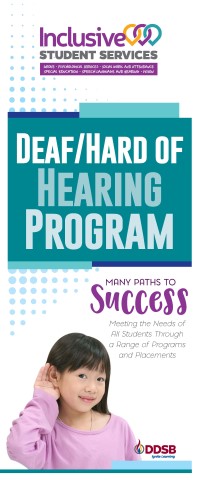
Special Education Class with Partial Integration
A special education class with partial integration that provides intensive support for students whose primary concern is speech and language related to their hearing loss. The program provides instruction in Ontario Curriculum as well as receptive and expressive language, auditory management and self-advocacy. Total communication is the focus for the program. Necessary spoken and visual supports are provided to develop receptive and expressive language and access curriculum.
Maximum of twelve students
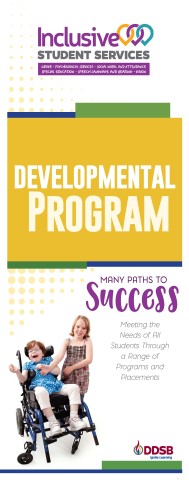
Full-time Special Education Program
The Developmental Program provides an intensive support program for students who have significant physical, intellectual or developmental disabilities. Students accessing the Developmental Program may also be medically fragile and/or require significant sensory support. The program also includes integrated community supports embedded within programming.
Maximum of six students
DDSB's Gifted program offers blended and separate educational programs for our gifted students. We also offer resources to parents, students and educators to support gifted learners.
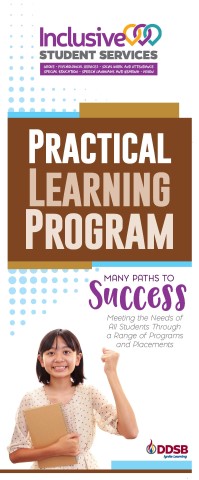
Special Education Class with Partial Integration or Special Education Class Full-time
The Practical Learning Program provides intensive support while teaching and reinforcing essential skills that foster independence in activities of daily living. This program is suited for students who may have intellectual disabilities, developmental disabilities, and/ or autism.
Maximum of ten students
Special Education Class with Partial Integration
The School Support Program provides an opportunity for an intensive support placement for the development of core curriculum and executive functioning (learning skills) for students within/ near their community school. The goal of the program is to foster independence and integration.
Elementary: maximum of ten students
Secondary: maximum of twelve students
Special Education Class with Partial Integration
The Structured Learning Class (SLC) provides intensive support for students diagnosed with Autism Spectrum Disorder (ASD) who are working on Ontario or Alternative curriculum expectations. Teaching strategies based on Applied Behaviour Analysis (ABA), ie. Structured Teaching TEACCH©, data collection, positive reinforcement and generalization, are utilized to develop skills in a variety of domains including but not limited to: communication, self-regulation, and social skills.
Maximum of six students
Self Contained Special Education Program
The DDSB Transition to Work program is designed to bridge between school and successful adult living by providing experiences in various work environments. The goal of the program is to develop employability skills and foster independence to support students with special needs to become productive workers with a goal of leading to meaningful employment. Through this program placement, students with special education needs can learn, practice, and refine productivity skills and social skills that are essential to participating in meaningful employment, learning more about themselves and the world of work.
Maximum of twelve students